
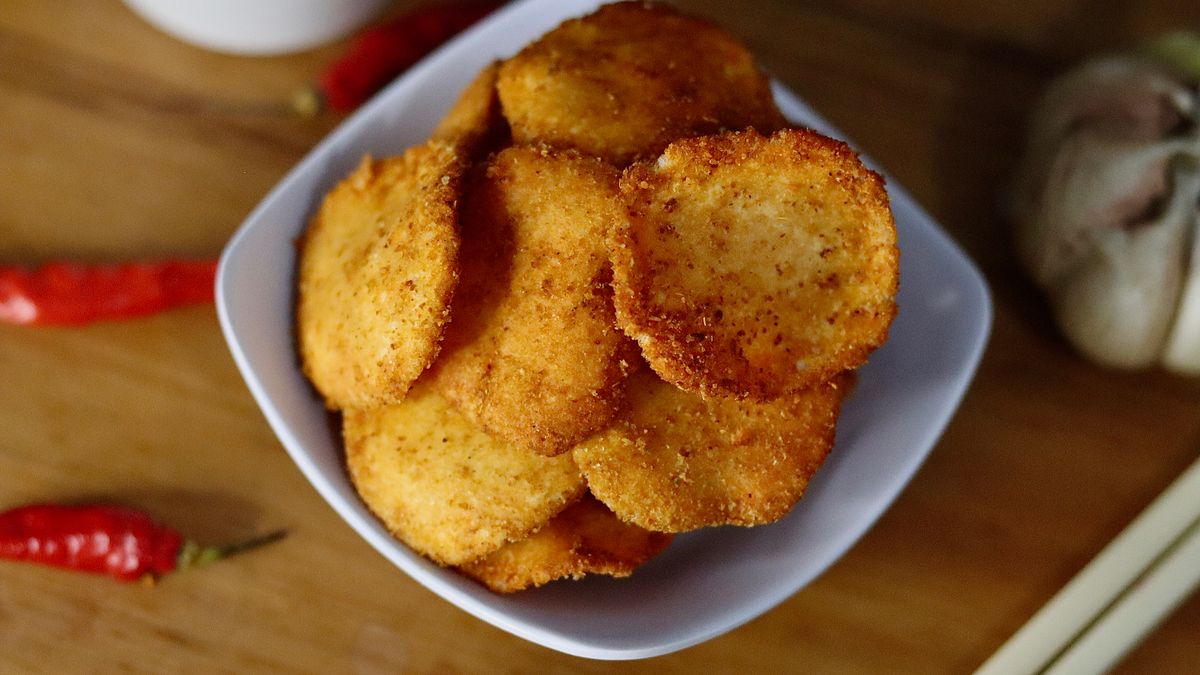
Every disappointing bag of salt and vinegar crisps fails in one of two ways. Either the vinegar arrives like a slap — a bright, searing hit that vanishes within seconds and leaves you with nothing but a dry mouth — or it never arrives at all, and you're eating salted crisps with a faint dusty ghost of something tangy. Both are balance problems, and both are fixable once you understand what's actually happening on your tongue.
The awkward truth is that acid is the flighty ingredient. Acetic acid, the sharp note in malt and distilled vinegars, is volatile: it lifts off the crisp, hits the back of your nose, and clears fast. Salt, by contrast, sits there stubbornly. Sweetness lingers in the middle. So a crisp seasoned by eye will nearly always end up either over-salted and under-acidic, or sharply acidic and hollow. Good salt and vinegar crisps are built, not sprinkled.
Think of the seasoning as a stool with three legs. Remove one and the whole thing tips.
Fat is the silent fourth element. A crisp cooked in good oil carries seasoning better and mutes harshness, so a richer, slower-fried crisp can take noticeably more acid than a thin, dry one.
You don't need a lab coat to taste crisps properly, but you do need to slow down. Try this with any bag:
Once you know the pattern, faults become easy to name. A crisp that tastes sharp then empty is running on volatile acid with no sweetness or savoury base behind it. A crisp that tastes flat and dusty has lost its acid, usually because the seasoning was applied to hot crisps straight from the fryer and the acetic acid evaporated. A metallic, throat-scraping tang means too much acid powder and not enough salt or sugar to buffer it — the crystals haven't dissolved properly in your mouth. And a crisp that tastes claggy has an over-fine seasoning that's clumping in the oil rather than sitting on the surface.
Home crisp-making is mostly about dryness. Slice waxy potatoes about 2mm thick on a mandoline, then soak the slices in cold water for half an hour to rinse off surface starch. Drain, then dry them properly — press between layers of kitchen roll and leave them to air for ten minutes. Any water left on the surface will spit in the oil and leave you with soggy patches.
Fry in groundnut or sunflower oil at 140°C for the first few minutes to cook them through, then lift the heat to 170°C until they're pale gold and the bubbling has slowed. Drain on a rack, not on paper. Salt immediately with fine sea salt while the oil is still hot, then dust with vinegar powder once they've cooled for a minute — acid added to hot crisps simply disappears. If you're using liquid vinegar instead, sprinkle it over, then return the crisps to a low oven for three or four minutes to drive off the water.
Start with a house blend for every 200g of finished crisps: one teaspoon of fine sea salt, half a teaspoon of caster sugar, and one to two teaspoons of vinegar powder depending on how bold you like it. Mix the powders thoroughly before dusting — a whisk or a small jar shaken hard does the job. Then adjust in small steps, tasting after every change.
Too sharp? Add sugar, not salt. Too flat? Add acid, then a pinch of salt to lift it. Too harsh? Try swapping half your distilled vinegar powder for malt, which is rounder and slightly sweet. Keep a notebook, because the batch you loved will be impossible to reconstruct from memory. And eat them the same day — home-made crisps soften within hours, and no amount of clever seasoning rescues a limp crisp.

Hi, my name is Anthony kuber. I am artist and fashion designer.
I love to travel and writing blogging.
Your email address will not be published. Required fields are marked *
Software Developer & Writer
Hey, I'm Diva, a developer and writer blending code and creativity. I'm driven by a deep curiosity and a relentless pursuit of excellence. Join me as I craft digital solutions and captivating stories.


